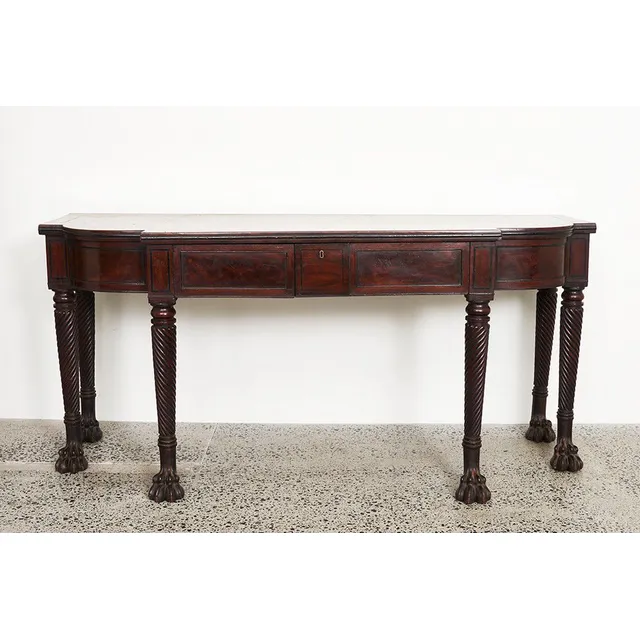
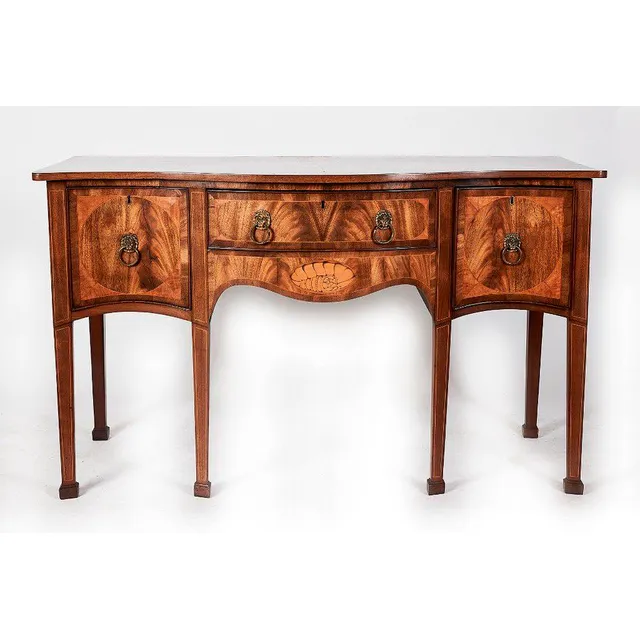
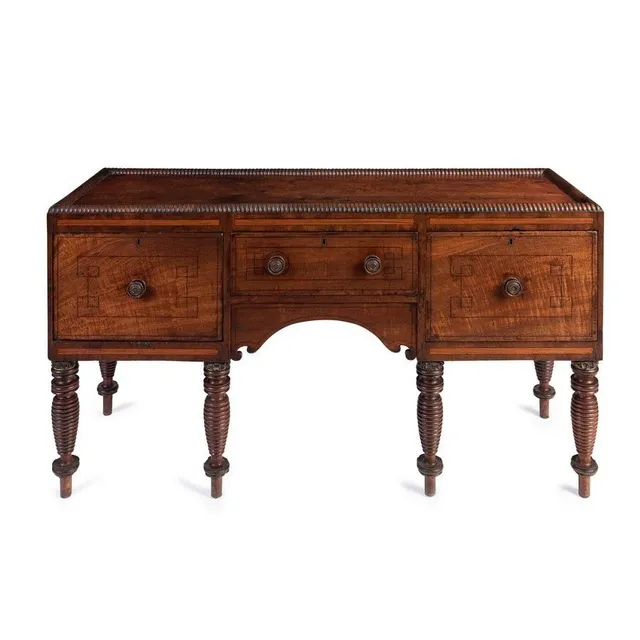
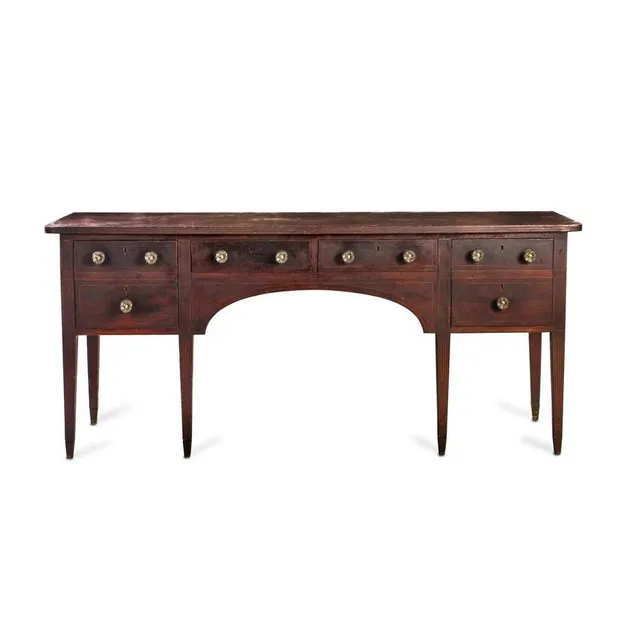
There are several distinct types of sideboard. The Georgian sideboard was a long narrow table, fitted with cutlery drawers and cellaret cupboards, used as a serving table in dining rooms. Most examples are at least five feet long.
Although sideboards date from the mid-18th century, their development is usually associated with the designs of Sheraton. Sideboards may be straight fronted, curved at either end, or sometimes have a recessed breakfront. The latter was partly to lighten the effect of a large piece of furniture and partly, writes Sheraton, 'to secure the butler from the jostles of the other servants'.
The central portion of the sideboard, beneath the long drawer, was usually arched with semicircular lunettes, either carved or often strung. The legs were sometimes turned, but more generally were tapered, often standing on spade or block feet. Georgian sideboards always have six legs one at each corner, one on
more...
either side of the central recess. Four legged sideboards were not introduced until the second decade of the 19th century.
Sideboards were usually made of well-figured mahogany or, in Australia, cedar or beefwood veneer, though very few colonial examples appear to have survived. They were sometimes cross banded, strung and inlaid with decorative panels of contrasting timber.
Another type of sideboard appeared in the late 19th century, based more or less on the Renaissance revival forms associated with designers Talbert and Eastlake. It consisted of a two-door cupboard, usually panelled and carved, with a mirrored back, containing shelves and a hutched or overhanging cornice, supported by turned or carved columns.
There are many variants, but the lines and angles were much squarer, handles were often of pressed metal alloy, and by the time the sideboard reached its full Edwardian flowering, it often boasted broken or swan-neck pediments, reeded and fluted decorations, and shallow machine-made carvings of shells, rosettes and other foliage.
The style continued to be made in mahogany, oak, maple, pine or cedar until after the first world war. During the 1920s, and under the influence of the modern movement, furniture forms became much simpler and less cluttered, taking on the characteristics pioneered by the Arts and Crafts designers a third of a century before. It should always be remembered that it may take a generation before an original design, breaking with tradition, becomes fully established in popular taste.
From around 1900 the size of sideboards began to decrease, in order to fit the smaller dining rooms of the day, although this example would still require a substantial room to display it properly.
less...
 Loading more...