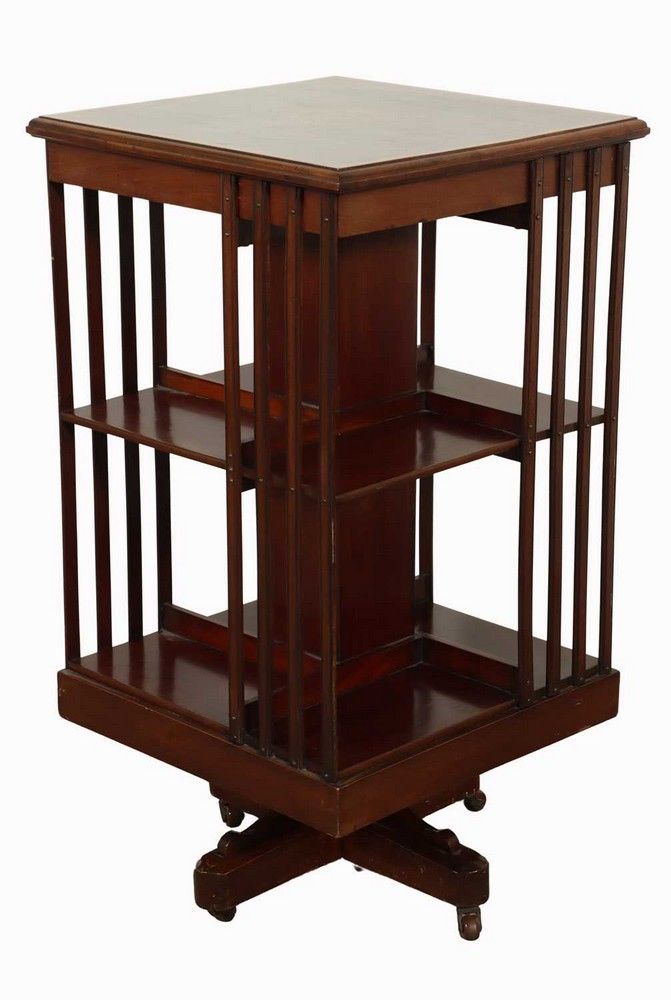
Late 19th Century Walnut Revolving Bookshelf with Marquetry Decoration
click the photo to enlarge


Revolving bookshelf, late 19th century in walnut with fruitwood string inlay and central circular marquetry decoration. Two tier open bookshelf mounted on a revolving quad base with brown porcelain castors. Height 91 cm, width 48 cm, depth 48 cm.
You must be a subscriber, and be logged in to view price and dealer details.
Subscribe Now to view actual auction price for this item
When you subscribe, you have the option of setting the currency in which to display prices to $Au, $US, $NZ or Stg.
This item has been sold, and the description, image and price are for reference purposes only.
- Inlay - Decorative patterns inserted into the main body of a piece of furniture, generally in wood of contrasting colour and grain, though brass, ivory, ebony, shell and sometimes horn have been used. Inlay may consist of a panel of well figured timber inset into a cabinet door front, geometric patterns, or complex and stylized designs of flowers, swags of foliage, fruits and other motifs. As a general rule, in pieces where the carcase is constructed in the solid, the inlay is relatively simple such as stringing, cross banding and herringbone banding. Where more elaborate and decorative work was required veneer was used. Inlay has been fashionable from at least the latter half of the 17th century, when a variety of elaborate forms were developed
- Marquetry - In marquetry inlay, contrasting woods, and other materials such as ivory, shell and metal are inlaid either as panels or in a single continuous sheet over the surface of the piece. The design may be straightforward, such as a shell pattern or a basket of flowers, or it may be infinitely complex, with swirling tendrils of leaves, flowers and foliage, such as one finds, for example, in the "seaweed" patterns on longcase clocks of the William and Mary and Queen Anne periods.
- Tier - One or more under-shelves of a table or cabinet.
- Castors - Wheels, fitted especially to chair legs, couches, tables and some smaller pieces of furniture, to enable them to be easily moved about. The earliest castors were of brass, with shanks fitting into the base of the leg, and the wheels often made of leather. In the late 18th century, brass 'bucket' or 'cup' castors were introduced, either rounded or square, fitting directly over the end of the leg and held in place with screws. The wheels were generally solid brass. Bucket/cup castors continued in use throughout the 19th century and indeed are still made today. In the later 19th century wheels were sometimes made of wood, china, either white or brown, and sometimes of steel.
- Fruitwood - A catch-all term used to describe the wood of any of several fruit-bearing trees, such as the apple, cherry, or pear, used especially in cabinetmaking.
With a blond colour when finished, fruitwood was used in Europe, especially France, in the 18th and 19th centuries for larger items of furniture such as tables, chairs, cabinets and bookcases but in England its use was generally restricted to decorative elements such as inlays. - Parquetry - Parquetry is inlay laid in geometric patterns, the contrast being achieved by the opposing angles of the grain and veneers. The herringbone pattern is the most commonly used in flooring, but this is almost never seen in furniture - the patterns used are more complex and unlike flooring, can include several different varieties of timber.
This item has been included into following indexes: