Antique Oak Dining Table with Carved Apron and Barley Twist
click the photo to enlarge


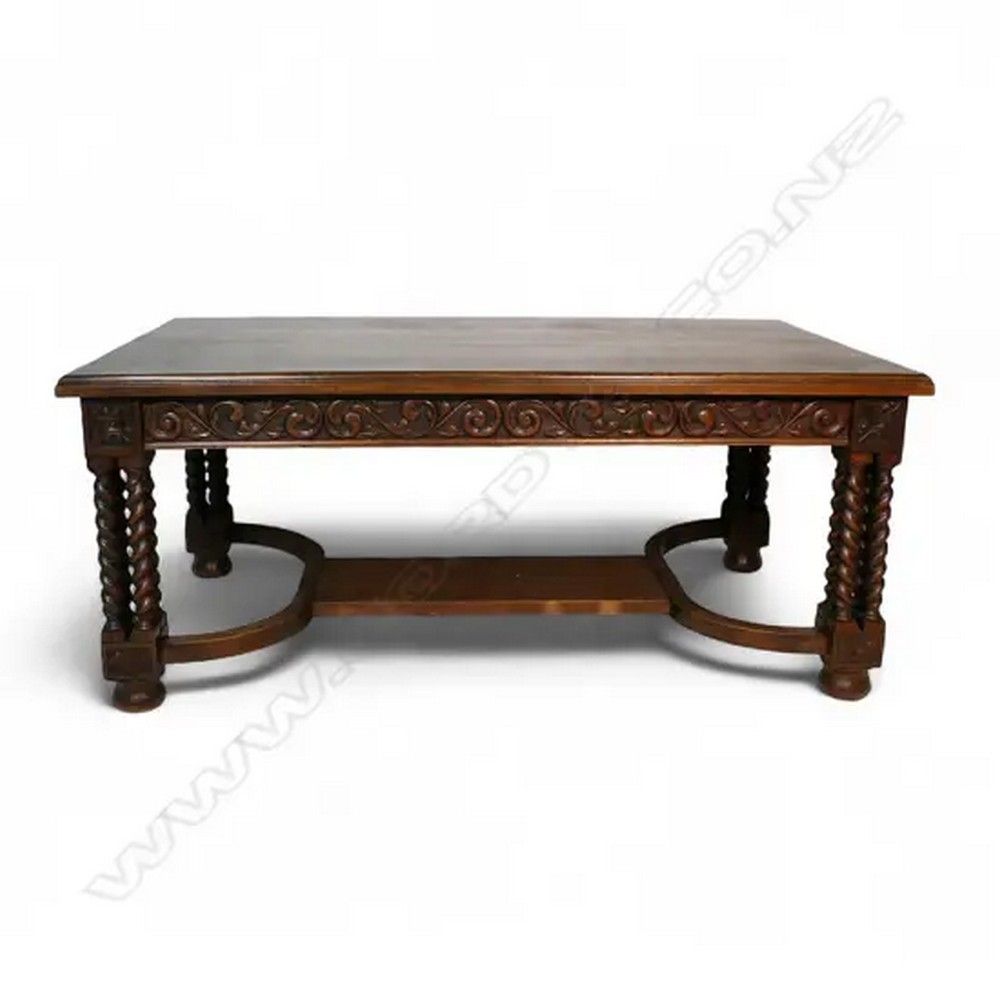
An impressive oak dining table, the top with decorative carved apron, four barley twist columns to each corner, raised on small square carved plinth and bun feet, curving stretcher base. 185 x 104 x 77 cm.
You must be a subscriber, and be logged in to view price and dealer details.
Subscribe Now to view actual auction price for this item
When you subscribe, you have the option of setting the currency in which to display prices to $Au, $US, $NZ or Stg.
This item has been sold, and the description, image and price are for reference purposes only.
- Bun Feet - Similar to ball feet, though somewhat compressed or flattened in appearance. Introduced during the late 17th century, but they have been used on furniture up to the present day.
- Stretcher - A horizontal rail which connects the legs of stools, chairs, tables and stands, to provide stabilisation of the legs. A stretcher table is any table with a stretcher base. The term is usually applied to substantial farmhouse tables, although many cabinetmaker's pieces, such as sofa tables, also have turned stretchers.
- Barley Twist - The leg, and frequently other uprights such as columns, chair frames, spindles and stretchers, are turned in fairly wide and deep spirals, usually slightly rounded. Also known as the 'Jacobean twist' and common on the dark stained Jacobean Revival furniture of the 1930s and 40s.
As a rule, the twists on opposite uprights should move in a contrary direction. Thus, if the spiral on a right side is clockwise, that on the left side should move in a counter-clockwise direction.
This is also true of rope-twist or cable-twist turning, a nautical term that came into fashion after Nelson's victories over the French fleet. The essential difference is that with rope twists, the spirals are more finely turned on the lathe and placed closer together, than they are with barley-sugar turnings. - Oak - Native to Europe and England, oak has been used for joinery, furniture and building since the beginning of the medieval civilisation. It is a pale yellow in colour when freshly cut and darkens with age to a mid brown colour.
Oak as a furniture timber was superceded by walnut in the 17th century, and in the 18th century by mahogany,
Semi-fossilised bog oak is black in colour, and is found in peat bogs where the trees have fallen and been preserved from decay by the bog. It is used for jewellery and small carved trinkets.
Pollard oak is taken from an oak that has been regularly pollarded, that is the upper branches have been removed at the top of the trunk, result that new branches would appear, and over time the top would become ball-like. . When harvested and sawn, the timber displays a continuous surface of knotty circles. The timber was scarce and expensive and was used in more expensive pieces of furniture in the Regency and Victorian periods. - Column - An architectural feature sometimes used for decorative effect and sometimes as part of the supporting construction. Columns should generally taper slightly towards the top. They may be plain or decorated with carving, fluting or reeding. Columns may be fully rounded or, more commonly, half-rounded and attached with glue, screws or pins to the outer stiles of doors, or the facing uprights on cabinets and bureaux.
- Plinth - The square or rectangular base of a piece of cabinet furniture, often ornamented with moulding. The plinth may be separate, as in some wardrobes or presses, and act as the support for the carcase. In a false plinth, the moulded boards may be attached directly to the piece. Furniture with a plinth base usually does not have separate feet. The term derives from architecture where it denotes the base of a column or statue.
- Apron - A decorative wooden panel that sits underneath the top surface of a table or chair, and unites the top of the piece with the legs, running at right angles to the underside. On carcase furniture such as a chest or wardrobe, the apron sits below the drawers or doors and attaches to the legs.
On carcase furniture without legs the panel under the drawers or doors sits on the floor and is termed a plinth.
An apron can provide a decorative touch to an otherwise unadorned piece of furniture and at the same time provide structural support and strength. They can be carved or pierced and quite elaborate.
This item has been included into following indexes: